
In Configuration Manager (ConfigMgr/SCCM), the Enclosure Chassis Types attribute provides valuable insights into the physical form factor of client devices. Whether you’re managing desktops, laptops, tablets, or virtual machines, understanding chassis type values helps administrators build dynamic collections, apply policies more effectively, and streamline hardware inventory reporting. This guide explains the different chassis type values, their descriptions, and how you can leverage them in SCCM queries.
As a Configuration Manager (ConfigMgr/SCCM) administrator, you may often need to create collections, queries, or reports based on different device types such as laptops, desktops, or tablets. The Enclosure Chassis Types attribute provides a reliable way to distinguish between these hardware categories. By using chassis type values, you can easily identify and group devices—for example, separating desktops from laptops—making it simpler to apply targeted policies, deployments, or compliance checks.
How to Check Chassis Type using PowerShell
The Win32_SystemEnclosure WMI class represents the properties that are associated with a physical system enclosure. You can check Chassis Type information using the PowerShell Get-WmiObject cmdlet.
Get-WmiObject -class win32_systemenclosure | select Caption,chassisTypes

How to Check Chassis Type from SCCM
The SystemEnclosure information collected from clients during hardware inventory is stored on SMS_G_SYSTEM_SYSTEM.ENCLOSURE class in SCCM.
Steps to Check Chassis Type in SCCM Resource Explorer
- Open the Configuration Manager Console
Launch the SCCM console on your admin workstation. - Navigate to Assets and Compliance
- Go to Assets and Compliance → Devices.
- Search for and select the device you want to inspect.
- Open Resource Explorer
- Right‑click on the device.
- Choose Start → Resource Explorer.
- Expand Hardware Section
- In Resource Explorer, expand Hardware.
- Look for System Enclosure or Enclosure Chassis Types.
- View Chassis Type Value
- The Chassis Type field will display a numeric value (e.g., 3, 8, 9).
- This value corresponds to the physical form factor (e.g., Desktop, Portable, Laptop).
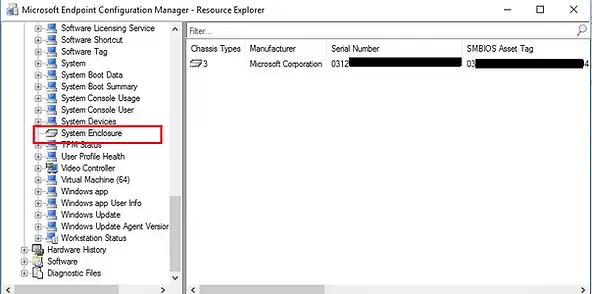
Below are the details of all Enclosure types as per the Microsoft article. We can use this enclosure chassis type to create a collection for Laptops and Desktops.
Enclosure Chassis Types, Value & Description
| Chassis Type | Chassis Type Value | Chassis Type Related To |
| Other | 1 | |
| Unknown | 2 | |
| Desktop | 3 | Desktop (Including virtual machines) |
| Low Profile Desktop | 4 | Desktop |
| Pizza Box | 5 | Desktop |
| Mini tower | 6 | Desktop |
| Tower | 7 | Desktop |
| Portable | 8 | Laptop |
| Laptop | 9 | Laptop |
| Notebook | 10 | Laptop |
| Hand Held | 11 | Laptop |
| Docking Station | 12 | Laptop |
| All in One | 13 | |
| Sub Notebook | 14 | Laptop |
| Space-Saving | 15 | Desktop |
| Lunch Box | 16 | Desktop |
| Main System Chassis | 17 | Servers |
| Expansion Chassis | 18 | Laptop |
| Sub Chassis | 19 | |
| Bus Expansion Chassis | 20 | |
| Peripheral Chassis | 21 | Laptop |
| Storage Chassis | 22 | |
| Rack Mount Chassis | 23 | Servers |
| Sealed-Case PC | 24 | |
| Tablet | 30 | Tablet |
| Convertible | 31 | Laptop or Tablet. For example, ThinkPad Yoga 370 will have a value of 31 since it can convert from a Notebook form factor to a Tablet form factor by rotating its screen on the 360 degree Yoga hinge. |
| Detachable | 32 | |
| IoT Gateway | 33 | |
| Embedded PC | 34 | |
| Mini PC | 35 | |
| Stick PC | 36 | |
Frequently Asked Questions (FAQs)
What are Enclosure Chassis Types in ConfigMgr/SCCM?
Enclosure Chassis Types are numeric values collected during hardware inventory. It describes the physical form factor of a device (e.g., desktop, laptop, tablet, server). They help administrators distinguish between device categories for reporting and policy targeting.
Why are Chassis Type values important for SCCM administrators?
Dynamic Collections: Easily group laptops vs. desktops.
Targeted Policies: Apply compliance baselines or deployments only to specific hardware types.
Inventory Reporting: Streamline hardware reports by filtering on chassis type.
How can I check a device’s Chassis Type using PowerShell?
Run the following command:
Get-WmiObject -Class Win32_SystemEnclosure | Select Caption, ChassisTypes
This retrieves the enclosure information directly from WMI.
Can Chassis Type values be used in SCCM queries?
Yes. You can use SMS_G_SYSTEM_SYSTEMENCLOSURE class in SCCM queries to filter devices by chassis type. For example, create a collection of laptops by querying for values 8, 9, 10, 13, 14.
Are virtual machines identified differently?
Yes. Virtual machines typically report as Chassis Type 3 (Desktop), so admins should be cautious when separating physical desktops from VMs.
Can I customize or override Chassis Type values?
No. These values are standardized by Microsoft WMI classes. However, admins can build logic in SCCM queries to interpret or group them as needed.
Related Posts:
- How to Create Dynamic Collection in SCCM
- Enclosure Chassis Types Value & Description | ConfigMgr | SCCM
- ConfigMgr: Maintenance Window for member of specific collection – SQL Query
- SCCM Dynamic Collection for Windows 10 / 11 Devices
- SCCM Device Collection Equivalents in Microsoft Intune for App Deployment
- SCCM Dynamic Collection Based on Device Type | Collection Queries
- SCCM Collection Based on Operating System Optional Features
- SCCM Device Collection Based on Installed Software Products & Inventoried Files
- SCCM Device Collection Based on Computer Hardware Details
- SCCM Collection Queries for Opearting System Attribute Class
- SCCM Collection Queries for System Resource (SMS_R_System) Attribute Class
- SCCM Dynamic Collection using Application Deployment Status
- SCCM Dynamic Collection Based on Configuration Baseline Compliance Status
- How to Create , View and Organize SCCM Maintenance Windows
- How to Provision Windows 10 / 11 Device using Intune and Windows Autopilot
Explore More SCCM Guides
Continue building your Microsoft Intune & SCCM skills with step-by-step tutorials covering device management, application deployment, automation, and troubleshooting.
- Microsoft Intune Learning – Explore comprehensive guides on device enrollment, compliance policies, application deployment, Windows updates, and more.
- SCCM (Configuration Manager) Guides – Explore more SCCM guides covering device management, application deployment, software updates, troubleshooting, and automation.
