
System Center Configuration Manager (SCCM) uses collection evaluation to update membership based on defined rules. While full updates run on schedules, incremental collection evaluation allows faster updates without waiting for the full cycle. This guide explains how incremental updates work, their advantages and limitations, and how IT admins can monitor performance using SQL queries, PowerShell, and the SCCM console.”
Configuration Manager uses the following threads to handle collection evaluation. The appropriate thread is executed depending on the evaluation type. For example, if the evaluation type is incremental, then the Express thread handle collection evaluation process.
- Primary for scheduled collection updates
- Auxiliary to manually update collections with dependent collections
- Single to manually update collections with no dependent collections
- Express for incremental collection updates
The following evaluation type is available for SCCM collections.
Manual(1): An administrator manually triggers a membership update.Periodic(2): The site does a full update on a schedule.Continuous(4): The site periodically evaluates new resources and then adds new members. This type is also known as an incremental update. It doesn’t do a full update on a schedule.Both(6): A combination of bothPeriodicandContinuous, with both incremental updates and a full update on a schedule.
This blog post is primarily focused on incremental updates. Hence, we will discuss collection incremental update, its pros and cons, and how we can identify the collections where incremental update is enabled.
- What is SCCM Incremental Collection Update
- Adjusting SCCM Collection Incremental Update Schedule
- SQL Query to list Collection with Incremental Updates Enabled
- PowerShell Command to list all Collections with Incremental Updates Enabled
- How to Enable or Disable Incremental Updates for a Collection
- How to Disable Incremental Update for a Collection via PowerShell
- Monitoring the performance of SCCM Incremental Collection
- Frequently Asked Questions (FAQs)
- Explore More SCCM Guides
What is SCCM Incremental Collection Update
An incremental update allows you to quickly add systems to a collection without performing a full membership evaluation. Configuration Manager continuously monitors and updates resource objects in all collections that are configured for incremental updates.
While incremental updates enable more frequent and near‑real‑time collection refreshes, they should be used carefully to avoid a negative impact on Configuration Manager site performance. Microsoft recommends enabling incremental updates on a maximum of 200 collections to maintain stability and efficiency
Given the potential impacts of incremental collections, it’s important to have a policy or procedure for creating the collections and assigning update schedules. Examples of policy considerations might be:
- Only use incremental updates for collections that are used for security scoping, client settings, and maintenance windows. These collection updates affect client behavior and access to resources.
- For applications with no licensing approval, advertise applications to existing collections, and use global conditions to restrict availability.
- Outline appropriate periods for other collections that have full collection updates scheduled.
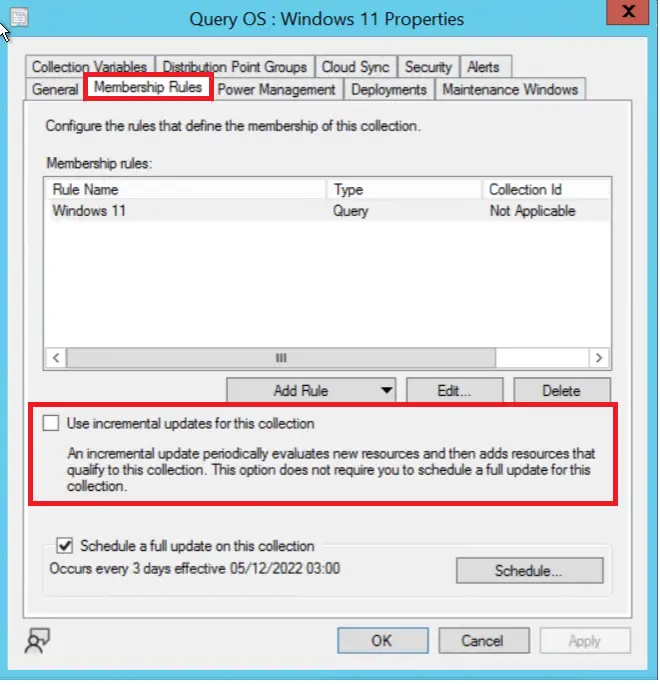
The incremental update can be configured from Collection properties > Membership Rules tab.
Adjusting SCCM Collection Incremental Update Schedule
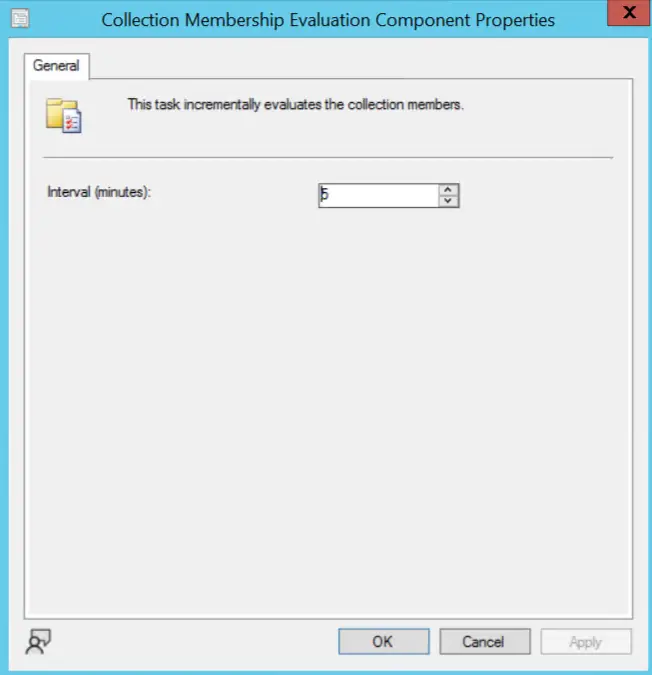
The SCCM collection incremental update schedule controls how frequently Configuration Manager evaluates collection membership. By default, this is set to 5 minutes, which is recommended for most environments to balance responsiveness and performance.
If needed, you can change the schedule by following these steps:
- Navigate to Administration > Overview > Site Configuration > Sites.
- Select your primary site server.
- In the ribbon, choose Configure Site Components > Collection Membership Evaluation.
- Adjust the incremental update interval as required.
SQL Query to list Collection with Incremental Updates Enabled
The following SQL query lists all SCCM collections with incremental updates enabled. You can also use this query to generate a custom report in Configuration Manager (SCCM) for monitoring and auditing purposes:
Select CollectionID, Name, Comment, LastRefreshTime,
CASE RefreshType
WHEN 4 THEN 'Incremental Update only'
WHEN 6 THEN 'Incremental AND Full Evaluation'
Else 'Unknown'
End AS RefreshType,
CurrentStatus, MemberCount
From V_Collection
Where RefreshType = '4' or RefreshType = '6' and CollectionID NOT LIKE 'SMS%'
PowerShell Command to list all Collections with Incremental Updates Enabled
The PowerShell Configuration Manager cmdlets can also be used to retrieve details of all collections where incremental updates are enabled. This is useful for admins who prefer scripting over SQL queries and want to quickly audit collection settings.
To run the command:
Launch PowerShell from the SCCM console using the Connect via PowerShell option.
Execute the following command:
Get-CMCollection | Select-Object CollectionID, Name, RefreshType | Where-Object {($_.RefreshType -eq 4 -or $_.RefreshType -eq 6 )-and $_.CollectionID -NotLike "SMS*"}
How to Enable or Disable Incremental Updates for a Collection
You can enable or disable incremental updates for a collection directly from the Configuration Manager console. Follow these steps:
- In the Configuration Manager console, navigate to:
Asset and Compliance > Overview > Device Collections or User Collections. - Right‑click the target collection and select Properties.
- Go to the Membership Rules tab.
- Check or uncheck Use incremental updates for this collection depending on your requirement.
- Click OK to save the changes.
⚠️ Best Practice: Microsoft recommends enabling incremental updates only for critical collections and limiting them to 200 collections maximum to avoid performance issues.
How to Disable Incremental Update for a Collection via PowerShell
You can use PowerShell Configuration Manager cmdlets to change the collection refresh type. Setting the refresh type to 2 (Periodic) disables incremental updates while keeping the periodic schedule intact.
Set-CMCollection -Name "All End User devices" -RefreshType 2
PowerShell Command to Configure Recurring Collection Evaluation
To update or create a recurring schedule for SCCM collection evaluation, use the New‑CMSchedule cmdlet. This cmdlet generates a schedule token in Configuration Manager, which can be applied to events with different frequencies such as daily, weekly, or monthly.
For example, the following PowerShell commands set the collection evaluation frequency to every 7 days:
$schedtoken = New-CMSchedule -DurationInterval Days -DurationCount 0 -RecurInterval Days -RecurCount 7
Set-CMCollection -Name "All End User devices" -RefreshType 2 -RefreshSchedule $schedToken
Monitoring the performance of SCCM Incremental Collection
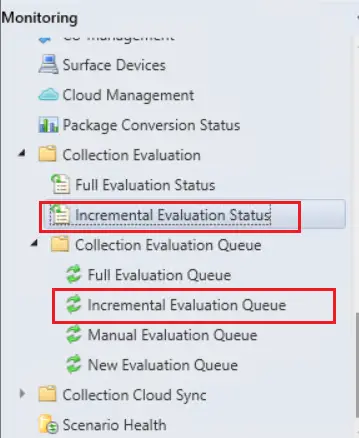
You can monitor the performance of incremental collections from the Monitoring > Collection Evaluation pane.
In the Incremental Evaluation Status, you can see all collections with incremental update enabled, membership last updated, and time taken to complete refresh. You can use this to understand which collection is taking more time to update.
The Incremental Evaluation Queue will show the list of all SCCM incremental collections that are in the evaluation queue.
Frequently Asked Questions (FAQs)
1. What is SCCM incremental collection evaluation?
Incremental collection evaluation in System Center Configuration Manager (SCCM) allows collections to update membership more frequently without waiting for a full scheduled refresh. This ensures near real‑time updates for critical collections.
2. How often does SCCM run incremental updates by default?
By default, SCCM runs incremental updates every 5 minutes. Microsoft recommends keeping this default interval to balance responsiveness with site performance.
3. How many collections should have incremental updates enabled?
Microsoft recommends enabling incremental updates for a maximum of 200 collections. Exceeding this limit can negatively impact Configuration Manager site performance.
4. How can I monitor incremental collection performance in SCCM?
You can monitor performance using:
- SCCM console (Collection Membership Evaluation component).
- SQL queries to list collections with incremental updates enabled.
- PowerShell cmdlets (
Get-CMDeviceCollection) for quick audits.
5. Can I disable incremental updates for collections?
Yes. You can disable incremental updates by:
- Editing collection properties in the SCCM console (Membership Rules tab).
- Running a PowerShell command:
Set-CMCollection -CollectionId -RefreshType 2
6. How do I configure recurring schedules for collection evaluation?
Use the New‑CMSchedule cmdlet in PowerShell to create recurring schedules (daily, weekly, monthly). For example, setting evaluation every 7 days:
$Schedule = New-CMSchedule -Start (Get-Date) -RecurInterval Days -RecurCount 7 Set-CMCollection -CollectionId -RefreshSchedule $Schedule
Conclusion
Incremental collection evaluation in SCCM is a powerful feature that helps administrators keep collections updated more frequently, ensuring accurate targeting for deployments and compliance policies. However, it must be used wisely—limiting incremental updates to critical collections and monitoring performance regularly. By combining incremental updates with well‑planned periodic schedules and leveraging SQL queries and PowerShell scripts for auditing, IT admins can strike the right balance between responsiveness and site stability. Following Microsoft’s best practices ensures your Configuration Manager environment remains efficient, scalable, and reliable.
Related Posts
- How to Create Dynamic Collection in SCCM
- Enclosure Chassis Types Value & Description | ConfigMgr | SCCM
- ConfigMgr: Maintenance Window for member of specific collection – SQL Query
- SCCM Dynamic Collection for Windows 10 / 11 Devices
- SCCM Device Collection Equivalents in Microsoft Intune for App Deployment
- SCCM Dynamic Collection Based on Device Type | Collection Queries
- SCCM Collection Based on Operating System Optional Features
- SCCM Device Collection Based on Installed Software Products & Inventoried Files
- SCCM Device Collection Based on Computer Hardware Details
- SCCM Collection Queries for Opearting System Attribute Class
- SCCM Collection Queries for System Resource (SMS_R_System) Attribute Class
- SCCM Dynamic Collection using Application Deployment Status
- SCCM Dynamic Collection Based on Configuration Baseline Compliance Status
- How to Create , View and Organize SCCM Maintenance Windows
- How to Provision Windows 10 / 11 Device using Intune and Windows Autopilot
Explore More SCCM Guides
Continue building your Microsoft Intune & SCCM skills with step-by-step tutorials covering device management, application deployment, automation, and troubleshooting.
- Microsoft Intune Learning – Explore comprehensive guides on device enrollment, compliance policies, application deployment, Windows updates, and more.
- SCCM (Configuration Manager) Guides – Explore more SCCM guides covering device management, application deployment, software updates, troubleshooting, and automation.
